M&A – what’s it all about, what’s the current trend with CFOs and what can they do to be prepared?
Navigating M&A, Growth, and Strategic Value Creation.
Jack B
12/1/20256 min read


M&A – what’s it all about, what’s the current trend with CFOs and what can they do to be prepared?
Navigating M&A, Growth, and Strategic Value Creation
There seems to be a trend with recent Finance job ads (from mid managers to senior i.e. CFOs) where they all magically require M&A exposure. How did this happen overnight? Read on….
What’s M&A?
Mergers vs Acquisitions: Understanding the Difference
Merger
Definition: When two companies combine to form a single new entity, often with shared ownership.
Characteristics:
Typically a “merger of equals”
Combined operations, management, and sometimes branding
Shared ownership and governance
Example: Exxon and Mobil merged in 1999 to form ExxonMobil, combining scale and market strength.
Best when:
Two similar-sized companies align strategically and culturally
Scale or combined market power provides competitive advantage
Acquisition
Definition: When one company purchases another, taking full or controlling ownership.
Characteristics:
Can be friendly or hostile
Target may retain brand or be fully integrated
Acquirer controls strategy and operations
Example: Facebook acquiring Instagram in 2012 to gain technology and market reach.
Best when:
A larger company wants to acquire technology, talent, or market access quickly
Goal is capability expansion or competitive consolidation
CFO perspective: The choice between a merger and an acquisition depends on strategy, valuation, integration risk, and market environment, not just opportunity.
Why CFOs Are Now in the Middle of M&A
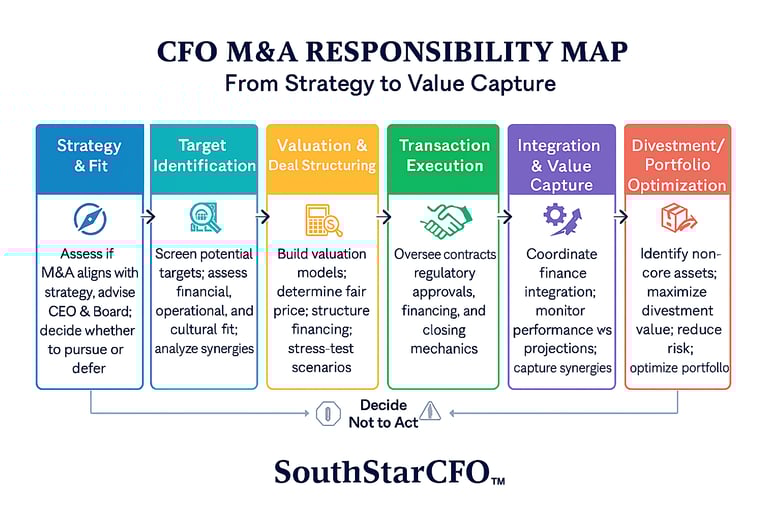
In today’s dynamic business environment, CFOs are no longer just financial overseers—they are strategic navigators and value creators. Boards and investors now increasingly expect CFOs to have hands-on M&A skills, participating in deal strategy, valuation, and integration. Why? Because each acquisition or divestment carries high stakes, historical deal success rates are low, and oversight at the financial and strategic level is crucial to prevent value destruction. Even if deal volumes haven’t skyrocketed, the depth of involvement required for each deal has grown dramatically.
Historical underperformance: 70–90% of deals historically fail to achieve projected value; CFOs now help prevent overpayment, poor integration, or regulatory missteps.
Higher stakes per deal: Every acquisition or divestment can significantly impact enterprise value. CFO oversight ensures deals align with strategic priorities.
From validator to navigator: Modern CFOs guide strategy, evaluate targets, structure deals, and monitor integration, ensuring alignment with the North Star.
Integration into BAU operations: CFOs track post-merger KPIs, synergies, and ROI as part of ongoing financial stewardship.
Accountability: CFOs are increasingly responsible for value creation and risk management, not just reporting.
In short: CFOs are more involved because the stakes are higher and boards demand real-time oversight, not because there are simply more deals.
CFOs are now true strategic partners
Boards and CEOs increasingly expect the CFO to:
Shape corporate strategy
Evaluate growth pathways
Challenge assumptions
Ensure discipline in capital allocation
M&A is one of the most important strategic levers — so the CFO naturally becomes a core architect.
Almost every value lever in M&A relies on CFO expertise:
Valuation
Pricing
Synergy modelling
Capital structure
Returns analysis
Scenario planning
Sensitivity and downside risks
Because deals succeed or fail financially, the CFO is best placed to lead or co-lead.
So what’s the CFO’s M&A Playbook?
Target Identification – Define criteria aligned with the North Star. Identify acquisitions or divestments.
Valuation & Stress Testing – Evaluate using DCF, comparables, and precedent transactions. Model synergies and risks.
Strategic Assessment – Decide whether M&A or alternatives are better aligned with long-term goals.
Deal Structuring & Negotiation – Assess payment mix, financing, and acceptable value ranges.
Due Diligence – Oversee financial, operational, tax, and regulatory diligence. Flag liabilities.
Integration & Monitoring – Track KPIs, synergies, and ROI post-merger. Embed into BAU.
Risk Management – Navigate regulatory, operational, cultural, and market risks across the deal lifecycle.
It feel like employers and boards are obsessed with M&A despite the risks. What are the Alternatives to M&A?
Organic Growth
Expand internally via new products, markets, or efficiency
Full control, lower risk
Slower growth, high investment
Strategic Partnerships
Collaborate via joint ventures or alliances
Shared risk, complementary resources
Less control, alignment challenges
Licensing / Franchising
Monetize IP or expand business model
Low capital, rapid expansion
Limited revenue control, brand risk
Internal Innovation / R&D
Build capabilities in-house
Proprietary assets, long-term competitiveness
Time-consuming, uncertain ROI
Divestitures / Spin-offs
Sell or spin non-core units
Frees capital, focus on core
Loss of synergies, perception risk
Minority Investments
Take minority stakes in other companies
Exposure without full integration risk
Limited control, smaller returns
Startup Partnerships / Incubators
Partner with startups for innovation
Early access to emerging tech
High failure rate, cultural misalignment
Key takeaway: M&A is a powerful tool but not always the best path. CFOs should ask: “Will this deal truly advance our North Star, or is there a safer, smarter path to growth?”
Developing M&A Skills: A Roadmap for CFOs
Even without live deal experience, CFOs and finance professionals can develop M&A expertise. Here’s what it looks like in practice:
Learn Core Frameworks:
Valuation: DCF, comparables, precedent transactions
Deal structuring: cash vs stock, earn-outs, risk allocation
Due diligence: financial, operational, tax, legal
Integration planning: KPIs, synergy tracking, post-merger reporting
Shadow Corporate Development Teams:
Participate in modeling, diligence, or integration exercises
Practice Scenario Planning:
Run mock acquisitions to stress-test valuation, risk, and strategy
Study Case Studies:
Analyze successes and failures from domestic and international deals
Certifications & Programs:
CMAP, M&A workshops, executive education courses
Build Transferable Skills:
Financial acumen, risk management, strategic judgment, negotiation
Outcome: Boards value framework, judgment, and strategic foresight as much as prior deal execution. A CFO who can model, assess, and advise with confidence is equipped to drive value creation without waiting for a live deal opportunity.
Why do so many deals not deliver then?
Many M&A deals fail to deliver the expected value — and the reasons are remarkably consistent across industries and deal sizes. Research from McKinsey, Bain, and Deloitte shows that 60–70% of acquisitions underperform, and about 50% destroy value.
Here are the most common reasons why:
1. Overestimating Synergies
This is the #1 reason deals fail.
CFOs and CEOs often:
Overestimate cost synergies
Assume revenue synergies that never materialize
Underestimate integration complexity
Fail to model realistic downside scenarios
What you gain on paper rarely matches what you can execute.
2. Poor Post-Merger Integration (PMI)
Most value is won or lost after the deal closes.
Typical failures:
No 100-day plan
Lack of clear accountability
Slow integration of finance systems + reporting
Culture clashes disrupting teams
Weak change management
Even strong deals lose momentum without tight integration leadership.
3. Deal Thesis Not Clear Enough
Often the strategic reason for the acquisition is vague or forced.
Executives pursue deals because:
“It looks cheap”
“We’ve always wanted to enter this market”
“Competitors are buying, so we should too”
If the thesis isn’t clear and measurable, execution becomes guesswork.
4. Paying Too Much
Overpaying kills more deals than any other financial factor.
Common causes:
Competitive bidding wars
CEO ego and “winner’s curse”
Misjudging the target’s future profitability
Ignoring integration costs
When the multiple is inflated, even perfect execution may not save the deal.
5. Weak Due Diligence
Rushed or superficial diligence leads to surprises post-close.
Examples:
Undiscovered liabilities
Hidden CAPEX needs
Overstated pipeline or customer concentration
Bad working capital assumptions
Poor diligence → bad model → bad deal.
6. Culture Clash
Often underestimated but massively destructive.
Conflicts in:
Decision-making style
Risk tolerance
Speed of operations
Incentive structures
Leadership behaviours
Culture eats synergies for breakfast.
7. Failure to Retain Key Talent
After a deal, high performers sometimes leave because they:
Don’t trust the new direction
Lose autonomy
Dislike new reporting lines
Don’t get retention incentives
Losing the wrong 5–10 people can collapse the integration.
8. Operational Disruption
Even a smooth acquisition can distract leaders from the core business.
During integration:
Sales dip
Customer satisfaction falls
Leadership is spread too thin
Employees focus internally instead of customers
Short-term disruption erodes long-term value.
Misaligned Leadership
CEO, CFO, COO, board, and PE sponsors must be in sync.
When they’re not:
Decision timelines slow
Priorities conflict
Integration stalls
Value capture becomes inconsistent
Deals fail more often when leadership doesn’t share the same playbook.
10. Poor Communication
Both internal and external communication matter.
Failures include:
No clear narrative for employees
Customers confused about changes
Integrators and operators not aligned
IT + finance teams miscommunicating
Small miscommunications compound into major execution errors.
M&A Fails When Execution Doesn’t Match the Story
Value capture depends on:
A realistic deal thesis
Accurate valuation
Aggressive but achievable integration
Strong leadership alignment
Transparent communication
A CFO-led integration discipline
When one of those fails, the deal misses its value.
Conclusion
M&A is a high-stakes, high-reward tool, but not a guaranteed growth engine. Modern CFOs are expected to be embedded in deals from start to finish, guiding strategy, valuation, integration, and risk management, while also managing day-to-day finance operations. CFOs need to asks tough questions, evaluates alternatives, and ensures every action — acquisition, divestment, or investment — moves the company toward its North Star. By learning the frameworks, shadowing teams, practicing scenarios, and building judgment, finance leaders can develop M&A mastery — even before executing their first deal.
The next blog will dive into a bit more detail on successful M&As!
Further Reading:-